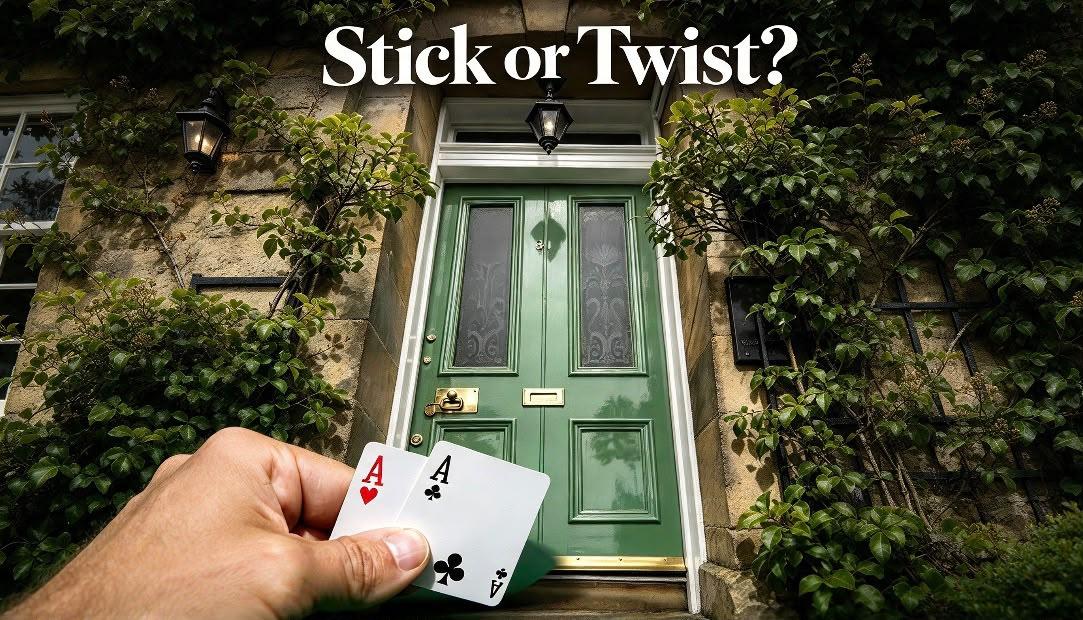
Sell now or wait? Stick or Twist?
Phil and I hear some version of the same question at almost every kitchen table right now. Do we go now or do we wait?
Stick or twist, really. Stick- and hold on until prices come back. Twist- and sell into the market as it is.
It usually comes up just after the Home Report has landed. The figure is lower than they hoped. Sometimes a lot lower. If they've spent money on the house, it stings even more. The new kitchen. The extension. The windows they finally got round to. (Lovely windows, usually. We do notice.) All of it paid for at today's prices, none of it showing up in the number.
We get it. We'd feel the same. Probably biased, but most homes we walk into are lovelier than their Home Report suggests. The Home Report doesn't do lovely.
The card nobody has turned over
This week a reel did the rounds. An investor responding to an economist who called the last two crashes and is now warning of falls of more than 30%. The investor doesn't buy the crash. One line he used stopped us both in our tracks.
Since the peak, house prices are down around 13% in real terms.
No crash. No headlines. It just happened, quietly, while everyone was watching for something dramatic.
We checked it for Scotland. The average Scottish home was worth £195,391 in August 2022. This August it was £198,000. Flat, on paper. Over the same four years everything else got about 17% dearer. That flat line is a 13% fall once you allow for it.
That's the card most sellers haven't seen. It's also why the Home Report feels like a slap. The surveyor values on what's selling now. Sellers value on 2022, plus a bit, plus the kitchen. The surveyor isn't being mean. They're just the first person to say it out loud.
Nobody has a crystal ball
We'd love to tell you what happens next. We can't. Neither can the economist predicting a crash, or the investor predicting a long flat spell. We're not economists, we sell houses.
What we can do is look at the cards on the table. Some of them come from the figures. Some come from our own patch.
What we're seeing
Buyers haven't gone anywhere. ESPC's latest figures show well-priced East Lothian houses selling in about three weeks, at or just above Home Report value. Our own Matchlist tells the same story. We treat it as a barometer for demand-
and right now it's steady. Quiet Seekers are still registering. They know what they want. They're looking in earnest.
What's changed is the money. Mortgages are dearer than they've been in three years. Buyers can borrow less, so they can pay less. They're still buying. They're just buying carefully.
Why sticking is the bigger gamble
Sticking feels like the safe play. Hold your nerve, wait for prices to catch up.
For that to work, prices would need to outrun inflation for years. Nobody is forecasting that. Not the crash camp. Not the calm camp either. The calm view in that reel is a few more soft months, then four years of weak sales. Prices that don't collapse aren't the same as prices that recover.
So if the next four years look like the last four, a home that stands still on paper keeps slipping in real terms. Every year. Without anyone noticing.
There's a ladder point too. If you're moving, you're buying in the same market you're selling in. The home you want has lost ground too. Waiting for your price to come back means waiting for theirs as well.
Our view
If you need to move in the next four years, for work, family, a downsize or to be nearer someone, we think there's a fair case for twisting sooner rather than later. While buyers are active. Before more listings arrive to compete with yours. Before another year of upkeep on a house you're planning to leave.
If you don't need to move, stick. Staying in a home you love is a perfectly good plan. We'll never talk anyone out of that.
Where we come in
The first question we ask at appraisal isn't about your house. Have you found where you want to go next? The second is just as direct. What's the least you'd take? Not the 2022 figure. Not the figure with the kitchen added. The number that makes your next move work.
We sense-check every valuation with an independent surveyor we trust before we share it. Through the Matchlist we often know the buyer before a home ever reaches the market. That lets us test your number quietly, off-portal, before anyone is dug in.
Better to see your cards over a coffee with us than to find out from a price reduction three months into a listing.
Stick or twist, the cards are yours. We'll just help you read them.
If a move is on your horizon, we'll come to you. No obligation. No pressure.
Book an appraisal at mowatt.uk/sellers
If you want to get into the figures
This is what we looked at to back up what we've said above. We've tried to be straight about where the numbers disagree.
Scotland: 13% down in real terms
The UK House Price Index puts the average Scottish home at £195,391 in August 2022 and £198,000 in August 2026. That's up about £2,600, or 1.3%. ONS consumer prices rose about 16.7% over the same period. To keep pace, the average home would need to be worth around £228,000. In real terms it's just over 13% lower. Our own sum, from the published figures.
East Lothian and Edinburgh: two sources, two stories
The official UK House Price Index has East Lothian at £301,272 in August 2022 and £286,314 in August 2026. That's 5% down in cash and around 18% down in real terms. Edinburgh went from £337,506 to £301,313. That's almost 11% down in cash and around 23% in real terms.
ESPC is kinder. Comparing June to August in each year, East Lothian's average selling price rose from £290,336 to £319,636. That's 10% up in cash and around 6% down in real terms. Edinburgh barely moved, from £316,475 to £317,070. That's around 14% down in real terms.
Why they differ
The official index covers every residential sale registered, including private sales that never went near an agent. Each sale is recorded when the title is registered, often months after the price was agreed. It also adjusts for the mix of homes sold. ESPC reports selling prices for homes marketed through its member solicitor agents, over three months, as a straight average.
Local numbers are also small numbers. A handful of large homes in North Berwick or Gullane can lift an East Lothian average on their own. A run of flats in Musselburgh can pull it down. Monthly local figures in the official index are provisional and often revised. Treat any single local figure with care. The direction is what matters. Every measure puts local homes somewhere between 6% and 23% lower in real terms than in 2022.
Buyer demand
ESPC's June to August figures show East Lothian houses selling in a median of 22 days, three days faster than last year. Houses achieved around 102% of Home Report value. New listings rose by almost 12%, so buyers have more choice.
Mortgage rates
In early October the average five-year fixed rate reached 6% for the first time in three years, according to Moneyfacts. The number of deals priced under 5% fell from almost 1,500 at the start of September to nine.
Inflation
ONS consumer price inflation was 3.5% in September 2026.
Building costs
BCIS forecasts building costs rising by around 13% over the next five years, on top of the sharp rises since Covid.
The reel
The reel's own view is no 2008-style collapse. It expects some further softness into next year, difficult affordability for around 18 months and four years of weak transactions. It points to household debt being far lower relative to income than in 2008, and to banks holding much more capital.
Sources: UK House Price Index (Registers of Scotland and HM Land Registry), ONS consumer price inflation, ESPC house price reports, Moneyfacts, BCIS.
